Best PCR Service Hospital in Chittagong
When a doctor recommends a PCR test, patients often want to know where to get tested, how the procedure works, and whether the results will help guide their treatment. Finding a reliable diagnostic facility is an important part of that process.
If you are searching for the best PCR service hospital in Chittagong, it helps to understand what PCR testing involves and how to choose a hospital that meets your specific testing needs.
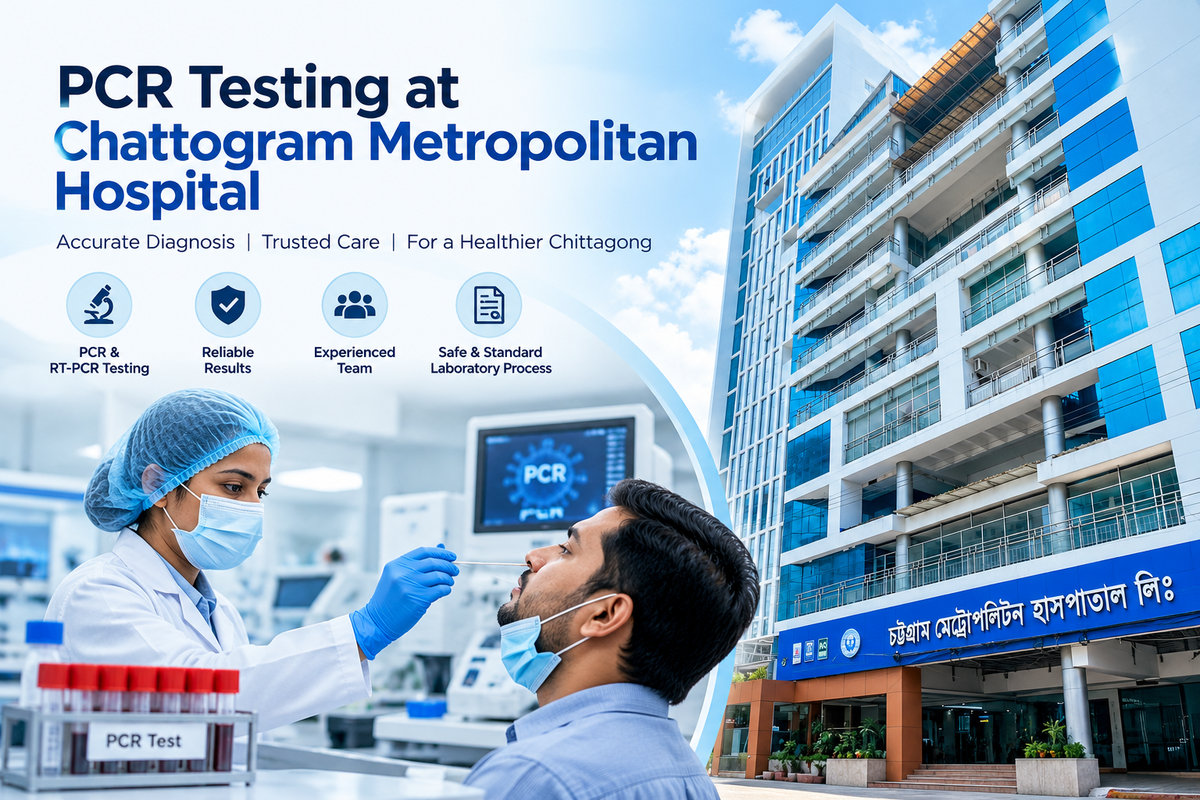
Chattogram Metropolitan Hospital Limited, located on O.R. Nizam Road in Chattogram, offers PCR and RT-PCR testing as part of its diagnostic services. Patients can contact the hospital to confirm the availability of the particular test prescribed by their doctor.
This guide explains PCR testing, its medical applications, sample collection, results, and the factors patients should consider when selecting a PCR testing hospital in Chattogram.
What Is a PCR Test?
PCR stands for Polymerase Chain Reaction. It is a laboratory technique used to detect specific genetic material, such as DNA, in a sample.
The method works by making many copies of a selected DNA sequence. This process, known as amplification, allows laboratory equipment to detect small amounts of genetic material that might otherwise be difficult to identify.
For certain infections caused by RNA viruses, laboratories use reverse transcription PCR (RT-PCR). This method first converts RNA into complementary DNA before amplification.
PCR-based tests are used for different medical purposes, including identifying certain infectious diseases, detecting specific genetic changes, and supporting selected cancer-related investigations.
However, each PCR test is designed for a particular target. A single PCR test cannot identify every infection or medical condition.
Why Is PCR Testing Important in Medical Diagnosis?
PCR testing can provide valuable information when doctors need to investigate certain infections or other conditions involving genetic material.
One advantage is its ability to detect very small quantities of a specific genetic target. Depending on the disease, specimen, and timing, this may help detect an infection before other testing methods can.
PCR testing may help healthcare professionals:
- Investigate certain viral or bacterial infections.
- Identify specific disease-causing organisms.
- Support diagnosis when symptoms overlap with other conditions.
- Detect selected genetic changes.
- Guide further medical investigations when clinically appropriate.
Although PCR is a sensitive laboratory technique, no diagnostic test is perfect. Results must be interpreted alongside symptoms, medical history, examination findings, and other relevant investigations.
How to Choose the Best PCR Service Hospital in Chittagong
Patients comparing PCR testing hospitals in Chittagong should look beyond advertising and online rankings. The quality and suitability of a diagnostic service depend on several practical factors.
1. Availability of the Required PCR Test
Not all PCR laboratories offer the same investigations. A facility may provide one type of molecular diagnostic test without offering another.
Before visiting, confirm that the hospital performs the exact test your doctor requested.
2. Appropriate Sample Collection
PCR testing can involve different sample types, including nasal swabs, throat swabs, blood, saliva, or tissue, depending on the investigation.
Proper specimen collection and handling are important because unsuitable samples can affect testing accuracy.
3. Laboratory Quality Procedures
Ask about the laboratory's quality-control procedures and how it handles diagnostic samples.
For specialized molecular tests, patients may also want to know whether testing is performed at the facility or through a referral laboratory.
4. Clear Reporting and Result Interpretation
A useful laboratory report should identify the test performed and provide results in a format that healthcare professionals can interpret.
Patients should consult their doctor when they are uncertain about a positive, negative, or inconclusive result.
5. Convenient Location and Communication
Hospital location, appointment procedures, sample collection times, report delivery arrangements, and contact information can influence the patient's experience.
These considerations can help patients choose a suitable PCR testing hospital in Chattogram.
Understanding PCR and RT-PCR Testing
PCR and RT-PCR are closely related techniques, but the terminology can be confusing.
Conventional PCR: This technique amplifies selected DNA sequences for laboratory analysis.
Reverse Transcription PCR: This method is used when the genetic target is RNA. The RNA is first converted into complementary DNA.
Real-Time PCR: Also called quantitative PCR (qPCR), this technique allows laboratories to monitor amplification in real time.
Real-Time RT-PCR: This combines reverse transcription with real-time detection and is commonly used in certain RNA virus investigations.
The exact technology required depends on the medical condition being investigated.
Chattogram Metropolitan Hospital Limited lists both PCR and RT-PCR-related services on its official website. Patients should confirm which tests are currently available before scheduling sample collection.
How Is a PCR Test Performed?
The PCR testing process generally includes several stages.
Step 1: Medical Recommendation
A healthcare professional determines whether PCR testing is appropriate based on symptoms, medical history, possible exposure, or another clinical indication.
Step 2: Sample Collection
A trained healthcare worker collects the required specimen.
For some respiratory infections, the sample may be collected using a nasal or throat swab. Other PCR investigations may require blood or another specimen.
Step 3: Laboratory Processing
The collected specimen is prepared for molecular analysis. Laboratory procedures are used to extract or process the genetic material required for testing.
Step 4: Genetic Material Amplification
PCR equipment amplifies the selected genetic target through repeated temperature-controlled cycles.
This makes small amounts of target genetic material easier to detect.
Step 5: Result Reporting
The laboratory reports the findings according to the test performed. Results may be positive, negative, inconclusive, or expressed in another format, depending on the investigation.
The time required for reporting varies by test, laboratory workflow, and sample processing requirements.
How to Understand PCR Test Results
Understanding your PCR test result is important, but the interpretation depends on what the laboratory was testing for.
Positive Result: The target genetic material was detected in the tested specimen. Its clinical meaning depends on the disease and the test.
Negative Result: The target was not detected. This does not always rule out infection, particularly when testing occurs too early, too late, or with an unsuitable specimen.
Inconclusive or Invalid Result: The test did not produce a clear, interpretable result. Repeat sample collection or additional testing may be necessary.
Patients should avoid making medication or treatment decisions based solely on a laboratory report without appropriate medical advice.
PCR Testing at Chattogram Metropolitan Hospital Limited
People looking for a PCR testing hospital in Chittagong can review the diagnostic services listed by Chattogram Metropolitan Hospital Limited.
The hospital's official website includes PCR and RT-PCR testing within its broader diagnostic service information. Other listed diagnostic categories include pathology, microbiology, biochemistry, and imaging services.
Patients interested in molecular diagnostic testing can review the hospital's PCR Diagnostic Service page for service information.
The hospital also maintains separate pages for RT-PCR and Rapid Antigen Tests.
Because different PCR investigations require different laboratory methods and samples, patients should contact the hospital to confirm the availability, preparation requirements, price, and expected reporting time for their prescribed test.
Where Is Chattogram Metropolitan Hospital Located?
Chattogram Metropolitan Hospital Limited is located in the O.R. Nizam Road area of Chattogram.
Hospital Address: 698/752, O.R. Nizam Road, Chattogram, Bangladesh.
Hospital Contact: +880 1814-651077
Patients can visit the official Chattogram Metropolitan Hospital website for information about hospital services and contact options.
Before traveling, call to confirm whether the required PCR test is available and whether any appointment or special preparation is necessary.
Frequently Asked Questions About PCR Testing in Chittagong
1. Where can I find PCR testing services in Chittagong?
Chattogram Metropolitan Hospital Limited offers PCR and RT-PCR testing as part of its diagnostic services. Patients can contact the hospital to confirm the specific investigations currently offered, sample collection arrangements, and appointment requirements.
2. What is the difference between PCR and RT-PCR?
PCR amplifies selected DNA sequences, while reverse transcription PCR includes an additional step that converts RNA into complementary DNA before amplification. The appropriate method depends on the target being investigated.
3. Is PCR testing accurate?
PCR is a sensitive molecular testing method when used appropriately. However, accuracy depends on the particular test, specimen quality, timing, laboratory procedures, and clinical circumstances. A negative result does not always exclude disease.
4. How long does it take to receive PCR test results?
PCR reporting times vary depending on the investigation, laboratory workload, processing requirements, and whether the test is performed on-site or elsewhere. Contact the diagnostic facility for its current estimated turnaround time.
5. How much does a PCR test cost in Chittagong?
The cost depends on the specific PCR investigation and the diagnostic facility. Patients should confirm the current price directly with the hospital before testing.
6. Can I take a PCR test without a doctor's prescription?
Requirements vary by test and facility. Some investigations may be available without a prescription, while others require a medical recommendation. Confirm the hospital's policy before visiting.
7. How should I prepare for a PCR test?
Preparation depends on the test and specimen type. Some tests require no special preparation, while others have specific collection instructions. Follow the guidance provided by your healthcare professional or diagnostic laboratory.
Conclusion
Finding the best PCR service hospital in Chittagong involves choosing a diagnostic facility that offers the required investigation, follows appropriate sample-handling procedures, and provides clear information about testing and reporting.
PCR is a valuable molecular diagnostic technique, but the right test and interpretation depend on an individual's clinical circumstances.
Chattogram Metropolitan Hospital Limited offers PCR and RT-PCR testing as part of its diagnostic services. Patients can contact the hospital to confirm current availability and discuss the next steps for their prescribed investigation.
For PCR testing information in Chattogram, contact Chattogram Metropolitan Hospital Limited through its official website or hospital service number.